Dehumidifier vs Absorbent Sticks
The Air Is Not Where Most of the Moisture Is Stored
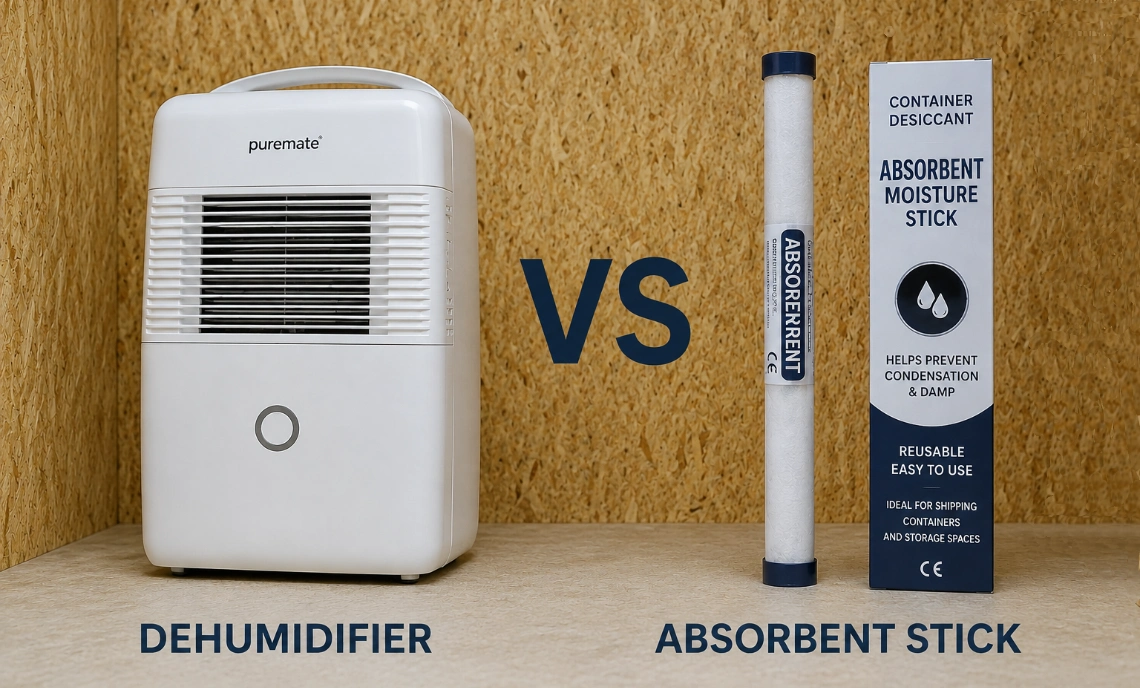
This is perhaps the easiest way to understand the difference between an absorbent stick and a dehumidifier.
A 20ft container at 80% relative humidity contains less than half a litre of water in the air.
Yet when we put a dehumidifier into a customer’s container full of belongings, we often remove around 10 litres of water.
So where did all that water come from?
If it was not all in the air, much of the moisture must have been released from the contents – mattresses, furniture, bedding, clothes, cardboard boxes and other materials that can hold moisture.
Why Does a Dehumidifier Work So Well?
The dehumidifier dries the air to the dryness level selected on the machine. As the air becomes drier, moisture held in clothes, bedding and other absorbent materials evaporates into the air.
It is just like wet clothing drying on a washing line. As moisture leaves the fabric and enters the air, the dehumidifier removes it.
The dehumidifier keeps doing this until the selected dryness level is reached. If the humidity rises again, it switches back on and removes more water.
This is how a dehumidifier can remove around 10 litres of water from a container even though there was less than half a litre in the air at any one time. Much of the additional moisture can be released gradually from the stored contents.
Why Is This Better Than Absorbent Sticks?
An absorbent stick also removes moisture from the air, but it has a limited capacity. A large container absorbent pole may collect around 2 litres of water before it needs replacing, although the capacity varies between products.
But the stick is not the only absorbent material in the container. Clothes, bedding, mattresses, cardboard and furniture absorb moisture too.
If the container door is opened on a damp day, or damp outside air enters through the container vents, that moisture does not necessarily go to the absorbent stick. The stored contents can absorb moisture as well.
A dehumidifier has an important advantage: it can keep the air at the selected dryness level. As moisture is released from the contents into the air, the dehumidifier can remove it.
Which Should You Choose?
With electricity: a dehumidifier can continually create drier air, allowing moisture to leave the stored contents and be removed.
Without electricity: absorbent sticks can help, but the amount of water they can remove is limited by their capacity and they need to be replaced when they have reached it.
That is the fundamental difference: an absorbent stick can collect a limited amount of moisture. A dehumidifier can control the humidity and keep removing water released from the stored contents whenever it needs to.
Why Electricity Matters in Container Storage
Many container storage facilities do not provide electricity to individual containers. Without electricity, customers who want additional moisture protection have little choice but to rely on passive moisture absorbers.
At Boxed Up, electricity is available as an option. This means customers storing clothes, furniture, bedding and other moisture-sensitive belongings can use a suitable dehumidifier to control humidity rather than relying entirely on absorbent sticks.
Our containers are also insulated to help reduce the temperature changes that contribute to condensation. Insulation helps reduce condensation; electricity gives you the option of actively controlling humidity.