Do Storage Containers Get Too Cold in Winter?
Will my belongings freeze in a storage container during winter?
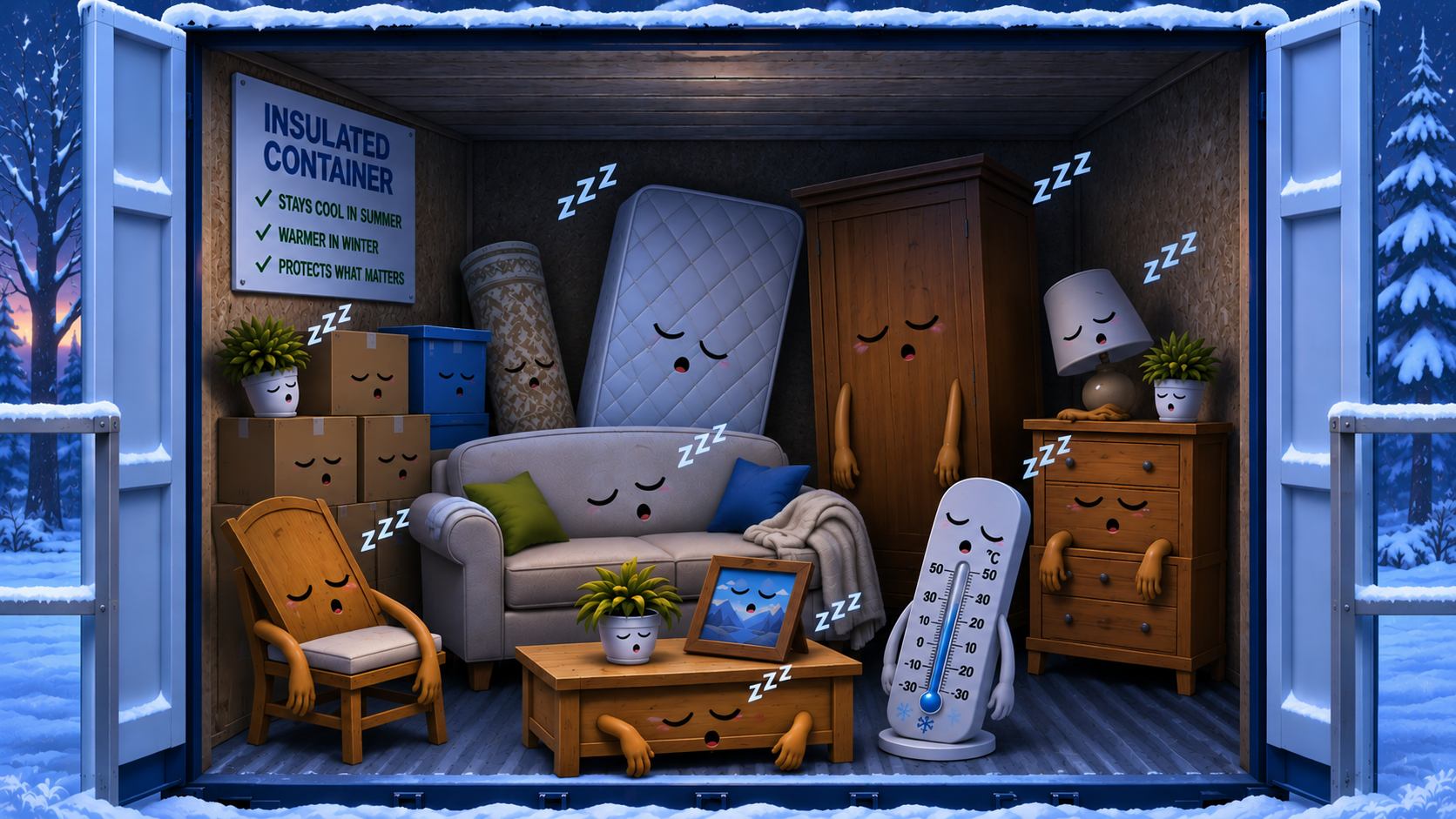
Not necessarily. An insulated storage container can help protect its contents from short periods of freezing weather by slowing down the loss of warmth. However, during prolonged freezing weather, an unheated container can eventually reach freezing temperatures.
Our containers are insulated primarily to reduce the heat entering during hot summer weather. This same insulation also slows the loss of warmth during winter, helping to moderate temperature changes throughout the year.
You can read more about summer temperatures in our article, Do Storage Containers Get Too Hot in Summer?
Can Cold Damage My Stored Belongings?
Most ordinary household belongings can tolerate low temperatures, provided they are clean, dry and properly packed.
Furniture, clothing, bedding and many household items are generally more vulnerable to dampness than to cold alone.
However, some products can be damaged by freezing, particularly liquids, water-based paints, adhesives and equipment containing water.
Always follow the manufacturer's storage instructions for temperature-sensitive products.
Which belongings are particularly sensitive to cold?
- Water-based paints and adhesives: Freezing may cause separation or permanent deterioration.
- Liquids: Water expands when frozen and can damage containers or equipment.
- Pumps and pressure washers: Residual water may freeze and damage internal components.
- Batteries: Different battery types have different permitted storage and charging temperatures.
- Electronics: Some products have minimum storage temperatures specified by their manufacturers.
- Antiques and delicate materials: Certain finishes, joints and sensitive materials may require controlled conditions.
Some of these products may also be restricted under our storage terms.
Can cold damage furniture and clothing?
Most ordinary furniture and thoroughly dry clothing tolerate cold storage reasonably well.
For wooden furniture, changes in moisture content are often more important than temperature alone. These changes can cause wood to expand or contract, affecting joints and finishes.
Clothing, bedding and fabrics should be completely dry before storage to reduce the risk of mould and mildew.
What about electronics and batteries?
Some electrical equipment can be stored at temperatures below those suitable for normal operation, but the permitted limits vary between products.
Lithium-ion batteries should not generally be charged below 0°C unless the manufacturer permits it or the battery has suitable protection.
When electronic equipment is brought from cold storage into a warm building, allow it to reach room temperature and ensure any condensation has evaporated before switching it on.
How Does Insulation Help Keep Belongings Warm?
Insulation does not produce heat. It slows the movement of heat between the inside and outside of the container.
For anyone interested in how this works, the following explanations show why an insulated container can protect belongings during short periods of cold weather.
How does insulation work? Think of a blanket
A blanket keeps you warm by reducing the amount of heat your body loses. Your body continually generates heat, and the blanket helps retain it.
A storage container works in much the same way, but with one important difference: stored belongings do not continually generate heat.
Furniture, boxes and other possessions retain warmth from earlier conditions. Insulation slows the loss of that warmth, helping them stay warmer for longer.
Without a continuing source of heat, the contents will gradually cool if the outside temperature remains low enough.
Why does a full container take longer to cool down? The two-stone example
Imagine placing two stones in a fire, one small and one large. The smaller stone heats up first because there is less material to heat. The larger stone takes longer.
When removed from the fire, the smaller stone also cools more quickly, while the larger stone retains its heat for longer.
The same principle applies to stored belongings. A container full of furniture, boxes and other possessions has a greater mass than an empty one, so it generally takes longer to cool down.
Insulation slows this cooling even further, creating a temperature time lag.
During a short spell of freezing weather, this delay may be long enough to prevent the contents from reaching freezing temperature before warmer weather returns.
The ability of materials to store heat is known as thermal mass.
What affects how quickly a container cools?
- Duration: A few hours of frost are different from several days of freezing weather.
- Severity: The colder it is outside, the greater the potential heat loss.
- Starting temperature: Warm contents have more stored heat available before reaching freezing.
- Thermal mass: The quantity and type of stored belongings affect how much heat they retain.
- Insulation: Its thickness and effectiveness influence how quickly heat escapes.
- Air exchange: Opening doors or allowing cold air to enter can increase cooling.
- Sunlight: Solar heating may help replenish warmth during the day.
If more heat is lost overnight than regained during the day, the contents can become progressively colder, even when daytime temperatures rise above freezing.
Is Condensation a Bigger Problem Than Cold?
For many household belongings, moisture is a greater concern than low temperatures.
Condensation can form when moist air meets a sufficiently cold surface. If moisture remains, it can contribute to mould growth and damage stored belongings.
Insulation helps reduce the risk of condensation on internal surfaces, although it cannot eliminate moisture problems entirely.
The best precaution is to make sure belongings are thoroughly dry before placing them into storage.
Why does condensation form?
Air contains water vapour. When moist air comes into contact with a surface below its dew-point temperature, some of that vapour can turn into liquid water.
Bare steel walls and roofs can become particularly cold during winter.
Insulation helps separate the internal environment from the cold steel, reducing the likelihood of condensation on the interior lining.
However, damp furniture, wet boxes or other moisture introduced during loading can still cause humidity problems.
At Boxed Up Storage, temporary dehumidifiers can be provided to help dry belongings that become wet during loading.
Why Don't We Allow Unattended Heaters?
Although heating could help maintain a minimum temperature, we do not permit customers to leave portable electric heaters running unattended inside our storage containers.
Containers may contain cardboard boxes, furniture, fabrics and other combustible materials. An unattended heater could overheat, develop an electrical fault or come into contact with stored belongings, creating a fire risk.
For this reason, our containers are insulated but not heated, and we cannot guarantee frost-free conditions during prolonged cold weather.
Items that must remain above freezing should be kept in temperature-controlled storage.
How Should I Prepare Belongings for Winter Storage?
A few simple precautions can help protect your possessions:
- Make sure furniture, clothing and boxes are completely dry.
- Remove liquids, water-based paints and other frost-sensitive products.
- Drain water from pumps, pressure washers and similar equipment.
- Check manufacturers' storage instructions for batteries and electronics.
- Use suitable packaging to protect delicate belongings.
- Allow cold electronic equipment to warm and dry before switching it on.
In Summary
Insulated storage containers help slow temperature changes and can protect ordinary belongings during short periods of freezing weather.
They cannot guarantee frost-free conditions during prolonged cold spells, so temperature-sensitive items require additional precautions or controlled storage.